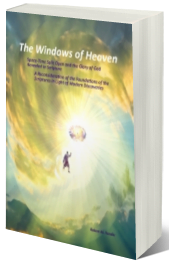
Recently, I was asked to participate in an online conference called The New Leaf Conference. As part of the conference, I participated in a question and answer session about my new book, The Windows of Heaven. Here is the second half of the script of the Q&A I had with the moderator that will show you at least 5 more things you didn’t know about science and the Bible.
3.Tell us a bit about your personal journey that led you to this point.
From a young age, I developed an interest in science. I was influenced by my brothers and friends who were always discussing ideas, building things, and learning things. I was also influenced by an uncle of mine who was a laser scientist and always shared interesting developments and scientific ideas whenever he visited.
In high-school, I was in an alternative program that allowed me to audit college courses. I loaded up on courses in general science. In the tenth grade, I completed the most advanced math class taught at the regular high-school and went on to complete college level courses in Astronomy, Calculus, and Physics. I build a reflective telescope, and while still in high school, I taught an introductory Astronomy course to my fellow students. I think it has always been the beauty and order of the world, as described by science, that fascinates me. The Scriptures also agree with that assessment to the degree that our English word “cosmos” derives from a Greek word that also means ornament or decoration. Our word “cosmetics,” also comes from the same word.
During my first year in college, I was introduced to Jesus Christ. Although I was spiritually changed, it took another year before I was introduced to a more accurate understanding of the Scriptures. After that, the Scriptures came to be, for me, what science was previously, and a desire began building in me to bring a greater understanding of the things I was learning to others. The things I had learned from science remained with me as well, and I always seemed to filter things through that understanding and filed them away in my mind over the years.
As I entered my career, I believe God allowed me to see many things as an encouragement. I’ve seen many different amazing things. I’ve been to air-force bases, Cape Canaveral, commercial nuclear plants and semiconductor plants in Silicon Valley. I saw the insides of reactor buildings including the blue glow that comes from nuclear fuel rods immersed in the reactor vessel water; I had a tour of a launch pad with a live Boeing Delta rocket on it, and I’ve seen ultra-clean electronics wafer fab facilities. During those years, I had learned many things, but I never shared most them and didn’t know what the purpose of them was.
In 2009, shortly after my wife and I moved to Arizona, something happened that caused me to become serious about communicating many of the things I had learned. At a dinner with some fellow believers, many questions were asked about scientific matters which drew many answers out of me. I began to realize the hunger people had to know the truth about these things and knew I had to start a book that was in me. The result is “The Windows of Heaven.”
I was also encouraged by Isaiah:
For as the rain cometh down, and the snow from heaven, and returneth not thither, but watereth the earth, and maketh it bring forth and bud, that it may give seed to the sower, and bread to the eater:
So shall my word be that goeth forth out of my mouth: it shall not return unto me void, but it shall accomplish that which I please, and it shall prosper in the thing whereto I sent it. (Isaiah 55:10-11 KJV)
If God put details in his word regarding the origin of all things, and His word brings forth fruit, then the sharing of these details should bear fruit.
4.What misconceptions does your book address?
Several. As many come from religion as come from science.
- Often the seven days mentioned in Genesis chapter one are referred to as the seven days of However, this is a complete misnomer, for in only three days involved an act of creation. Also, the original creation of the heavens and the earth is separate and distinct from the seven days mentioned and precedes them.
- There is a misconception that the discipline of Science is, by nature, at odds with the belief in God. However, many of the top scientists in believed in God.
- One of the appendices shows parallels between science and the Scriptures. Science prepares the mind to think in terms of abstract, invisible entities, such as those the Bible declares.
- The distant stars were not made on the same day as the Sun and Moon. In Genesis 1:16, it says “he made the stars also.” However, the words “he made” are in italics indicating they were added by the translators. The greater context shows that they do not belong in the text.
- Biblical chronology is typically thought to be a farce. The scholar Ussher determined that the world must have been created 4004 BC. However, as scientific evidence emerged in the mid-1800s showing that the earth was millions of years old, theologists discounted Ussher’s results and virtually the entire Bible with it. When we understand that Genesis declares Earth became without form and void rather than being created in such a state, and when we realize that 2Peter 3:5-6 describes a cataclysm that destroyed the original Earth, we realize that the earth can be much older than Ussher’s chronology with no contradiction. Ussher’s date simply marks the start of the chronology of the Bible starting with the restoration of the earth and not the time of creation.
5.What are the main lessons can we take away from this work?
- The foundations of the Scriptures are sure.
- Science harmonizes with the Scriptures, but one has to be willing to aside preconceived ideas to achieve this harmony.
- There are three different levels or realms of life in the things God made formed and created. The third and highest level, Spirit Life, is tied to the entire purpose for man. The first two levels are familiar to us.
- Body-physical cellular level: This level blows away man’s technology.
- Soul-Life: Level of animals. Soul-Life enables movement and intelligence.
- Spirit-life: the places man in the realm of God and angels.
- Without understanding the plan of the Redeemer, Jesus Christ, the Bible makes little sense. Without understanding. Without understanding spirit-life, the plan of Jesus Christ makes little sense.
- The testimony of the Scriptures is consistent throughout. Genesis one is not just some strange myth tacked onto the beginning of the Bible that no one should believe. It fits with the overall plan laid out in the Scriptures and sets the foundation for them.
- There is a purpose for you and me. God wants you to come home to him. The very good of Genesis reestablished in Christ. God may have been waiting billions of years to see his passion come to pass.
If you’d like to read my book and learn more about how science and the Bible, you can buy it here.
Be First to Comment