One of the most unique celestial events in a several centuries happened just weeks ago. A Jupiter-Saturn conjunction occurred, which happens every 20 years, but it was the closest conjunction since 1623. Not only did Jupiter and Saturn almost merge into a single point to the naked eye, it happened exactly on the winter solstice. That caught my attention and made me wonder what significance it had, not based on astrology, but based on biblical astronomy. What significance would this have had to the Magi in biblical times?
To discern this, we have to understand that thousands of years before the Bible was written, the story of Christ the redeemer was portrayed in the stars by assigning names and images to stars, planets, and the constellations. These actors play out a drama every night. The names of the stars and constellations were passed down to us from before history was written, and they tell a similar story in most ancient languages. The Witness of the Stars, by E.W. Bullinger, first printed in 1893, offers a gateway into this ancient knowledge. (This book is in the public domain and a PDF can be downloaded for free).
The heavens declare the glory of God; and the firmament sheweth his handywork. Day unto day uttereth speech, and night unto night sheweth knowledge. [There is] no speech nor language, [where] their voice is not heard. [Psalm 19:1-3 KJV]
The Players
Before we can understand what God might be communicating via a celestial event, we must understand the players in the drama.
- The Constellations. There is a story associated with the groupings of stars known as constellations. The twelve zodiac constellations are of prime importance since the planets move through these constellations.
- The Stars. The most important thing that ties together the story of the constellations is the names of the stars. “He telleth the number of the stars; he calleth them all by [their] names.” [Psalm 147:4 KJV]
- The Planets. Each planet represents a certain character or deity in ancient astronomy. As they move across the backdrop of the stars they tell a story.
- The Sun and the Moon. These also have a meaning in and of themselves, but they play little role in the particular drama we are covering.
The specific players in the event we are focused on are Jupiter, Saturn, and the constellations Sagittarius and Capricorn. Also of concern are some of the star names in these constellations.
Sagittarius
Starting on page 62, this constellation is described in The Witness of the Stars as follows:
(Sagittarius).. is occupied wholly with the triumph of the Coming One, who is represented as going forth “conquering and to conquer. “The subject is beautifully set forth in the written Word. (See Psalm 45:3-5)
John, in his apocalyptic vision, sees the same mighty conqueror going forth (Revelation 6:2). The Hebrew and Syriac name of the sign is Kesith, which means the Archer. The Arabic name is Al Kaus, the arrow. In Coptic it is Pimacre, the graciousness, or beauty of the coming forth. In Greek it is Toxotes, the archer, and in Latin Sagittarius.
The names of the brightest stars are significant: Hebrew, Naim, which means the gracious one. We see the same in the Arabic names that have come down to us: Al Naim, the gracious one; Al Shaula, the dart; Al Warida, who comes forth; Ruchba er rami, the riding of the bowman.
An ancient Acadian name in the sign is Nun-ki, which means Prince of the Earth.
Capricorn
In The Witness of the Stars page 74:
In all the ancient Zodiacs, or Planispheres, we find a goat with a fish’s tail. In the Zodiacs of Denderah and Esneh, in Egypt, it is half-goat and half-fish, and it is there called Hu-penius, which means the place of the sacrifice.
In the Goat we have the Atoning Sacrifice, in the fish we have the people for whom the atonement is made.
The Goat is bowing its head as though falling down in death. The right leg is folded underneath the body, and he seems unable to rise with the left. The tail of the fish on the other hand seems to be full of vigour in life.
The star alpha (the brightest star) is named Al Gedi, the kid or goat, while the star delta is called Deneb Al Gedi, the sacrifice cometh.
Jupiter
Jesus Christ Our Promised Seed, by Victor Paul Wierwille, describes the biblical significance of the planets. On page 38 we read:
In mythology Jupiter was the father of gods, the ruler, the king who reigned over all else. Jupiter was associated with royalty. Interestingly, the Hebrew name for the planet Jupiter is ssedeq, meaning “righteousness.” The Messiah who would come from David’s genetic line was to be the “righteous Branch,” according to Jeremiah 23:5, who would reign as a king and execute righteousness. His name would be called “the Lord our righteousness” (Jeremiah 23:5 and 6; Jeremiah 33:15 and 16). Thus Jupiter has characteristics that would associate it with the Messiah, the Christ.
Saturn
Saturn’s significant associations have been obscured more than others, although Saturn is identified as the god responsible for agriculture and the harvest. In astrological lore, Saturn is an evil star signifying death in darkness. Likewise in Jewish tradition its usual signification is negative, for it is associated with death, destruction, weeping, and grief. It was felt to have a hindering and inhibitive force in its negative aspect, especially when in conjunction with another planet.
The Event
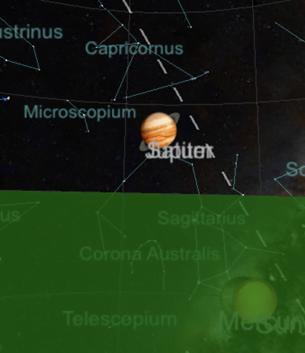
Jupiter reached the closest point of separation with Saturn on Dec 21, 2020, the winter solstice. Technically, the crossing occurred in the constellation Capricorn, but it was more between Capricorn and Sagittarius. Jupiter moves faster than Saturn and overtook Saturn while moving out of Sagittarius and into Capricorn. Below is a graphic of the crossing.
The Interpretation
Christ (Jupiter) has come forth to overtake and pierce (arrows of Sagittarius) the darkness and destruction (Saturn). He is personally (close conjunction) intervening and confronting evil (Saturn) to move us from darkness to light (following the solstice, days get longer), and into a fuller knowledge of the depths of deliverance wrought in his sacrifice (Capricorn, lamb part) and its results for his people (Capricorn, fish part).
Be First to Comment